Investor brief · September 2026
Proxeno
The data-led transaction platform for buying and selling Australian general practices.
Raising $300,000
Kate Marie | Medius Global | mediusglobal.com.au
The business broking landscape
1 in 12 practice owners intend to leave within five years.
Nowadays 82% of non-owner GPs do not want to own a practice, so traditional buyers are disappearing.
Owners now must sell to external buyers.
About 175 practices a year face an owner who is retiring and they will come to market with fewer known buyers.
The problem
The market is inefficient.
For sellers, too few bidders hold the price down. For buyers, they regularly miss the best deals.
Both parties pay too much for the transaction.
Sellers often take the first bidder
The first suitor is rarely the best payer and often the seller is not presented with the full range of ideal buyers. Once exclusivity is implied, the seller has no benchmark and no leverage. The deal closes before any competition can raise the price.
The perfect buyer might not be asked
No one sees the whole buyer universe. A broker works from their contact list and 86% of brokerages are one man bands. The ideal buyer may not hear about the practice, so the seller then takes whoever comes first.
The broker has no reason to say wait
The broker is paid when the practice sells, so a sale now is worth more to the broker than a higher price later. Preparing the business first would lift the price, but the wait earns the broker nothing, so nobody advises the seller to take the twelve to eighteen months it needs.
Brokers inflate prices to win listings
To win the listing, the broker quotes a price the seller wants to hear, then stands behind that figure to keep the mandate. Priced above what a buyer will pay, the practice sits unsold, and the deal stalls or dies.
Broker fees are highest on small deals
Typically broker fees are 6% to 12% of the sale price. For smaller deals there’s a floor: minimum fee of $15,000 to $30,000. With a large sale the percentage sets the fee, on a small one the minimum does, so the effective rate climbs as the price falls. A $25,000 minimum on a $220,000 sale is about 11%, and higher on anything smaller.
Price set by rule of thumb
Brokers value on a multiple of EBITDA, but with no published sales data the multiple is a rule of thumb. Once the owner’s own billings come out, a smaller practice shows little profit, so the real price rests on what a particular buyer will pay to keep its GPs, which a generic multiple does not capture.
Buyers and sellers do find each other, but by chance and without the data to know whether the match is right. Both settle for less than the best deal would have paid.
The answer
Proxeno is a matchmaker, not a broker
Proxeno takes its name from the proxenos of ancient Greece: a citizen who helped foreigners trade in his city. Legal disputes, trade connections, introductions. Much like a modern consulate.
His allegiance was public, and his reward was standing and honours, not a share of what his guests traded.
A GP owner selling a practice is the merchant arriving in a strange city. The proxenos existed to close that gap.
A broker is paid a percentage of the sale price, so the broker’s interest sits inside the deal. A proxenos is paid for the work of the match, so his interest sits with the people he serves.
One declared side per deal
Proxeno acts for one party and says which, and never values, buys or holds a practice.
Fixed fees for defined work
Agentic AI does the process work previously done by humans, so the fee is fixed, known up front and a fraction of a broker.
Matched on the data, not a contact list
The platform scores each practice against the mapped buyer universe, so the seller sees every buyer that fits and why.
Proxeno earns on the match, not a cut of the price and AI keeps the cost low enough to also offer that to the smaller seller.
The gap
Brokers work from a contact list, charge commission and have never sat in the seller’s seat.
About 700 licensed brokers work across roughly 200 broking firms and 86% of those firms are single-operator businesses. Buyer registers, listing histories and bid data stay inside each firm.
The licence tests agency conduct, not knowledge of general practice. No one in the channel has run a practice, so sellers are advised by people who have never sat in their seat.
We have run the business
The team has negotiated practice acquisitions, taken new businesses to market, run and owned practices and groups, have deep rural, accreditation and educational experience.
We work the deal, not the listing
A broker lists and waits. Proxeno matches each practice or group against the recorded criteria of the buyer universe and already knows which buyers it fits. The deal is worked and shaped actively so the end deal is a perfect match for each party.
Both sides are mapped before any calls
The seller sees who the buyers are, what they want and why each is on the shortlist. The matching is a data query, not a contact book. The elements deemed as important to each side are tallied up before the first approach.
The unlock
We have mapped the buyer and seller universe
6,424
general practices documented in the GP Zoo dataset
4,382
independent practices
342
group operators, enriched and geolocated
2,042
group sites
Proxeno launches knowing both sides of the market. Every practice is mapped, the 342 group operators are geolocated, and Medius already reaches the sector through its research and information products.
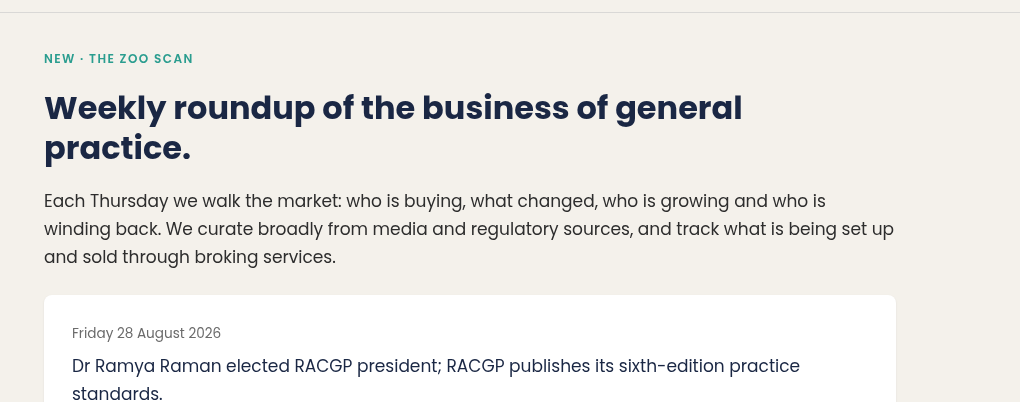
Each week the Proxeno agent reads broker websites and business-for-sale portals and compiles two indices: new practice openings and brokered sales. The Zoo weekly edition reports buy-side and sell-side movements. Medius publishes the three titles shown here.
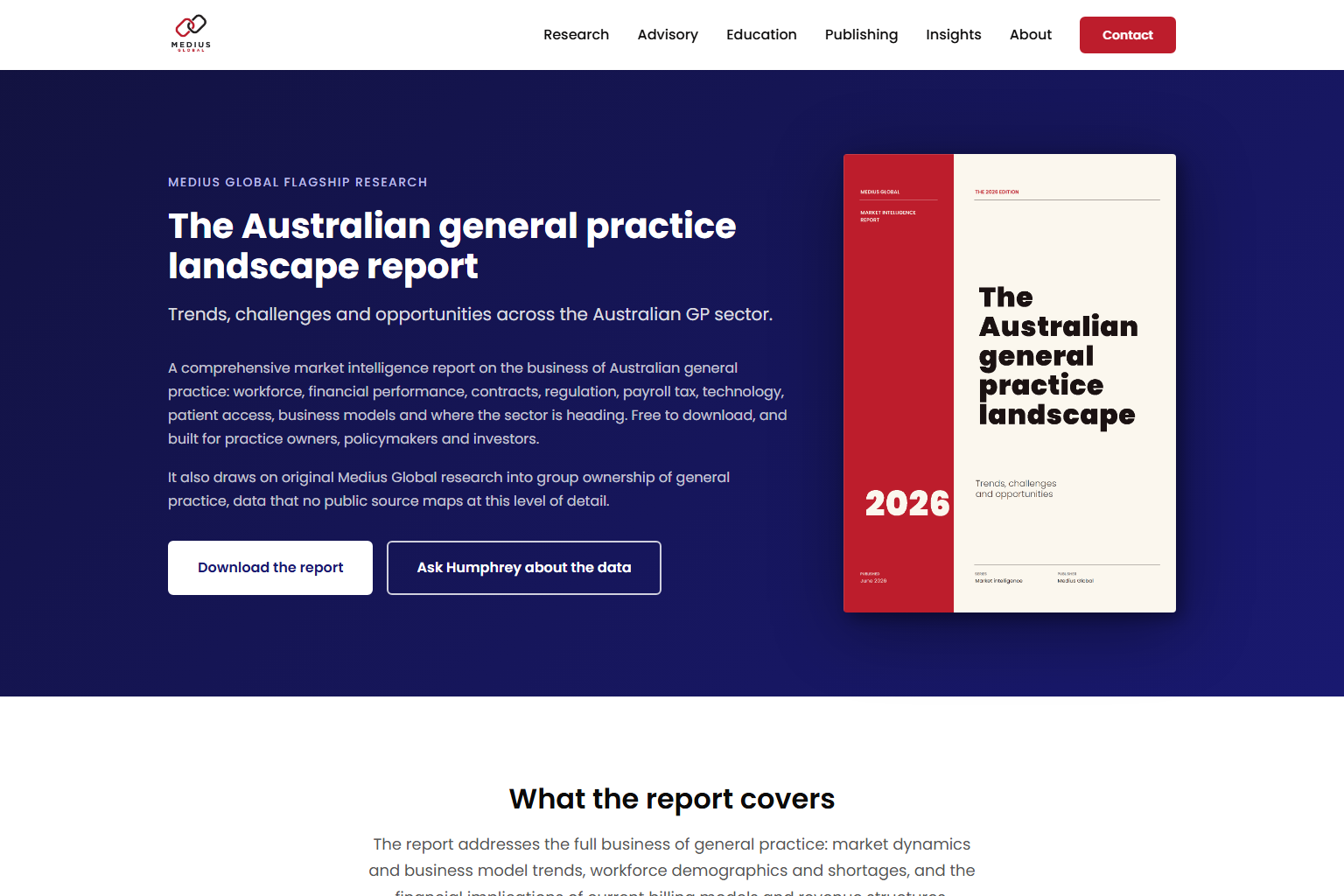
The Australian general practice landscape report
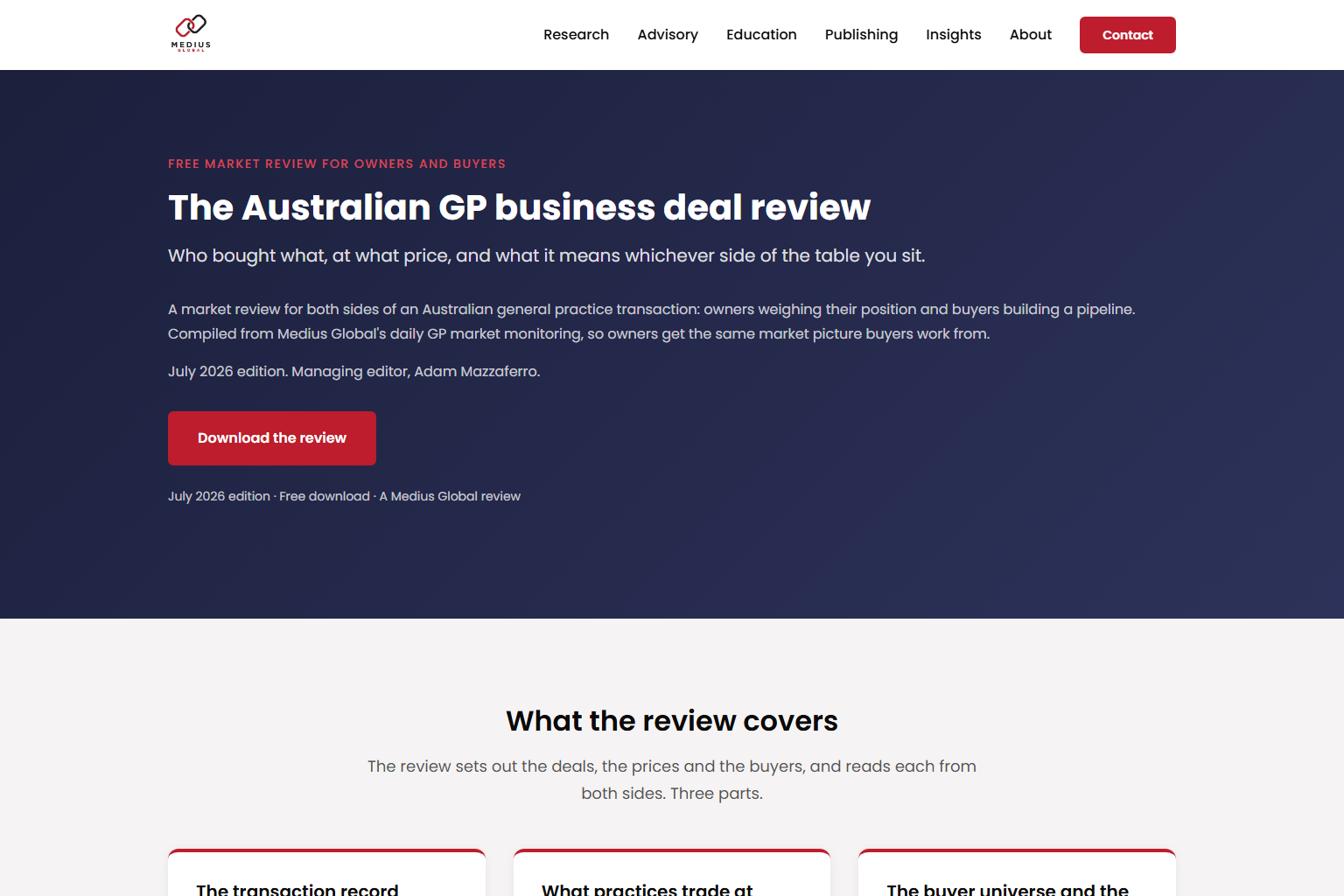
The Australian GP business deal review
The platform
Discovery
Formal engagement
Matching
Sell side
The matching engine
Buy side
Transparency of transaction
The underlying data layer
Enter
Owners register at any time to explore their options. All records are de-identified until they ask to be listed.
Business acuity assessment
Evidence-based evaluation of practice performance, scored across six domains.
Sale readiness assessment
Evaluation of readiness to sell, scored across five domains.
Practice optimisation (optional)
Consultant work to lift performance or valuation before sale.
Seller criteria capture
Seller engages with the platform proprietary mix of operational and aspirational data to inform optimal buyer matching.
Grading
Attractiveness scoring: which buyer types the practice suits, and the fee band.
AIMatch review & management
AI generates the match which is then verified by a Proxeno management consultant pending discussions with the seller. Document flow and buyer outreach are managed within the platform.
Buy side data set
A group operator records standing acquisition criteria: states, size, structure, posture.
Buyer criteria capture
Buyer engages with the platform proprietary mix of operational and aspirational data to inform optimal matching with sellers.
Match
Buyers scored against the seller’s criteria. Shortlist developed.
AIPrepare
AI assisted document creation and management including marketing materials to support the buyer engagement process.
AIApproach
Proxeno approaches matched buyers with the permission of the seller.
Documentation
AI managed document flow, including NDAs, business documentation to and from accountants and buyers.
AIBuyer data sets
6,424 practices, 342 operators, 2,042 group sites. 4,382 independent practices. Referral networks such as accountants and recruiters.
Market observation
Active monitoring of the market using agentic AI including new practice openings and practice sales indices.
Data lake
Practice data at depth behind the tools: scores, readiness history, engagement stages.
Knowledge system
Business and market evidence base. Humphrey answers from it, the reports are derived from it.
The difference
Unlike incumbent advisers, Proxeno covers the whole sale.
| An accountant | A broker | Proxeno | |
|---|---|---|---|
| Sight of the whole buyer market | ✗ | ✗a private contact book | ✓GP Zoo data |
| Tailored approaches to matched buyers, the deal worked to completion | ✗ | ✗advertises and waits | ✓ |
| Several qualified buyers at the table | ✗ | ✗ | ✓ |
| Fixed fees, not commission | ✓ | ✗6% to 12% and minimums | ✓ |
| Preparation before the market sees the practice | ✓ | ✗not paid to prepare | ✓free until sale readiness ends |
| Confidential outreach, no public listing | ✓ | ✗ | ✓ |
| Support for buyers & sellers along the way | ✗ | ✗ | ✓ |
| The seller’s valuation | ✓ | ✓ | ✓via the owner’s accountant |
| Delivery by people who have run practices | ✗ | ✗ | ✓ |
The fee model
Proxeno charges a fixed fee which is agreed on engagement.
| Accountant | Broker | Specialist adviser | Proxeno | |
|---|---|---|---|---|
| Calculation | Hours: $150 to $250 standard, $350 to $450+ for partners. | 6% to 12% of the sale price, minimum $15,000 to $30,000. | 1% to 10% of the sale price, plus a retainer of $3,000 to $15,000 a month. | Deal valued per GP, set before work starts. |
| Payment terms | Billed, sale or no sale. | At settlement. | Monthly retainer, sale or no sale; balance on settlement. | Upfront platform fee, balance on deal completion. |
| Service coverage | Preparation for due diligence ($1,000 to $5,000) and valuation ($2,500 to $6,000); hourly rates on deal management. | Listing, advertising and negotiation. | Preparation, buyer research, approaches, negotiation, due diligence. | Preparation, matching, buyer approaches, document management, then handover to the buyer for due diligence. |
| Suitable for | Any business. The engagement covers the financials and valuation, not the sale. | Sellers prepared to pay a minimum fee of $15,000 to $30,000. | Businesses from about $5m valuation. | Practices with more than 3 GPs. |
| Transparency in deal cost | No, hourly fee driven. | No, linked to EBITDA or sale price. | No, monthly retainers plus a percentage of an unknown price | Yes, fixed and documented. |
| Fee example, average 6 to 9 GP practice (7.2 GPs) | $3,500 to $11,000 preparation, then hourly fees. | $15,000 to $30,000 minimum or 6% to 12% of the sale price, whichever is greater. No published sale prices exist for a dollar example. | $3,000 to $15,000 monthly fees plus commission on sale. | About $37,200 on a completed sale: $5,000 at engagement, the balance at completion. Fixed, whatever the practice sells for. |
Proxeno charges a fixed fee based on GP numbers. The others bill by the hour, the sale price or the month.
The cost
A broker charges $25,000 to sell a $220,000 practice.
The plan’s worked example: a small practice selling for $220,000. This would be the minimum fee charged by a broker, about 11% of the price.
A broker’s fee is a percentage and increases with the sale price. Proxeno’s is fixed, regardless of what the practice sells for.
The revenue
Platform transactions are 81% of revenue.
Base case, twelve months: 46 practices coming to market, 8.5 whole-group sales, 12 of 342 operators buying. About 36 transaction engagements, 19 practice optimisations and 19 data products.
Platform transactions
$675,630 · 81%
The sale or purchase, completed on the platform.
DIY packages
$6,496platform only
Supported sale, 6 to 9 GPs
$33,053consultant-delivered
Supported sale, difficult tier
$28,597consultant-delivered
Whole-group sales
$127,800in-house
Buyer acquisitions, group operators
$383,747in-house and consultants
Buyer acquisitions, large independents
$95,937in-house and consultants
Optional preparation
$96,938 · 12%
Consultant work to lift a practice before sale.
Practice optimisation
$96,938optional
Data products
$60,500 · 7%
Self-serve, no consultant.
Standalone buyer mapping
$24,500self-serve
Matched-buyer reports
$36,000self-serve
The platform handles matching, documents and workflow. A consultant handles the deal where one is needed. All deals are managed on fixed fees and not a percentage of sale price.
The model
The base case banks 39% of a $2.15m fee pool.
| Conservative | Base | Upside | |
|---|---|---|---|
| Annual revenue | $437,190 | $833,068 | $1,487,014 |
| Fixed costs | $351,588 | $351,588 | $351,588 |
| Delivery cost, on the platform | $65,579 | $124,960 | $223,052 |
| Fees, in-house and consultants | $132,493 | $258,591 | $462,938 |
| Total costs | $549,660 | $735,139 | $1,037,578 |
| Annual profit | -$112,470 | $97,929 | $449,436 |
Delivering an engagement costs about 15% of the fee, $124,960, carried by the platform. The larger cost is human, $258,591 paid to consultants and the in-house team on the engagements they deliver. Fixed costs are $29,300 a month: $12,300 running the business (tools, SaaS and AI, the data engineer, insurance, legal and accounting), $13,000 sales and marketing, $4,000 promotional and travel.
The fee pool comprises transaction fees from both buyers and sellers, plus our data products. The capture rates behind the base case are modest: 1 in 10 sellers coming to market, 1 in 3 group sales, 12 of the 342 mapped operators and 5 of the 392 large independents buying. Sale volumes are planning inputs.
The friends and family round is in. Proxeno is now raising $300,000.
The expansion plan
43,000 adjacent health businesses, 6.8 times general practice.
20,919
dental businesses
9,963
physiotherapy
about 6,000
PBS-approved pharmacies
3,411
optometry
2,921
diagnostic imaging
The platform functionality is transferrable across to the broader health market without significant changes: the observation layer, the scoring and matching engines, the workflow and the fee model. Only the ownership dataset is rebuilt for each new vertical. We’d add one vertical at a time from month 24. Half the adjacent pool at the GP capture rate is about $2.4m annually, against the base case’s $833,068.
Before the next move: the dataset, matching engine and fee model proven on completed GP transactions, and the published data set functioning as the market authority.
The status
Platform development.
Shipped
- Ownership dataset6,424 practices, 342 operators, daily
- GP Business Acuity Evaluationgrades the business
- GP Practice Sale Readiness Assessmentscores readiness to sell
- Daily market scansbroker listings, practice openings
- Internal data setsownership lineage and site-level detail, refreshed on schedule
- Buyer and seller criteria capturesecure data catchment forms, live
Building
- Matching enginebuyer criteria scored against practices
- Document assemblythe seller’s five documents
- Data lakepractice data at depth: scores, readiness history, engagement stages
- Founding consultant cohortthe first accredited consultants, recruited and trained to deliver supported sales
Next
- Identity, consent and paymentsidentity checks, consent records and payment rails
- Owner preferences formeach owner separately, laid side by side
- Values and culture matching engine
Every engagement feeds the dataset: buyer demand, what is selling and on what terms, building the first index of sale and close-rates in Australian general practice.
The team
General practice, health M&A, sales and AI engineering.
Kate Marie
Go-to-market, health tech advisory, channel management and industry stakeholder engagement, over 25 years in the Australian health system. She has negotiated 15 medical centre acquisitions and built the Medius assets behind Proxeno.
Tyson Reynolds
Healthtech platform building, operations and partnerships. Co-founder of New Frontier Health, which he grew to a $5 million valuation in 18 months serving 150 practices, and a health researcher across general practice and public health.
Kerron Bromfield
25 years in operational and executive health management. Group practice and primary and urgent care establishment, feasibility workups and economic modelling, with depth in regional and rural care. An accredited AGPAL assessor.
Fahad Muhammad
Data engineering, data architecture and business intelligence, 17 years across regulated industries on Databricks, Snowflake, AWS and Azure.
Dr Chris Mitchell AM, FAICD
Clinical leadership, health policy and governance. Co-founder of Medius Global, a rural GP of 35 years and a Past President of the RACGP, made a Member of the Order of Australia in 2013.
Adam Mazzaferro
Corporate and commercial law and health M&A. A partner at MillerPrince with 20 years advising health businesses, and formerly General Counsel and CEO of a medical centre group that grew from 2 to 12 practices.
The channels
Proxeno launches into channels Medius already works
The products that bring people in
Zoho CRM and campaigns
Practices, group operators and practice managers on one list, segmented and contactable.
How we reach them
The data is already the answer
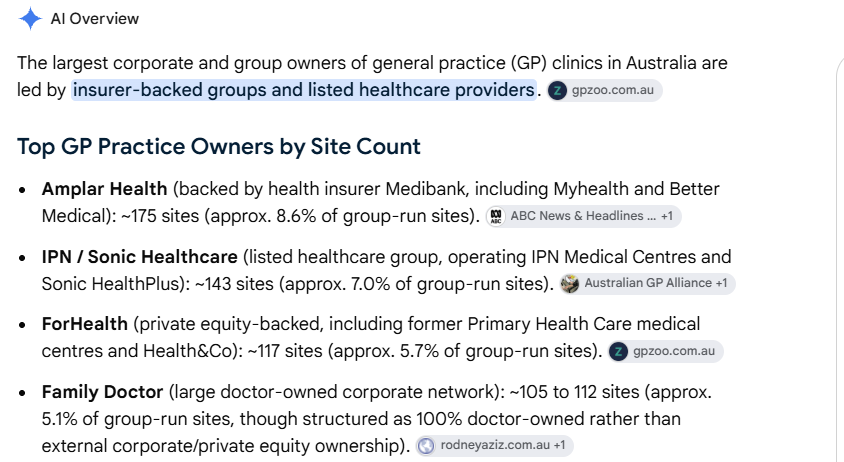
Google’s AI Overview answers ‘who are the largest corporate owners of GP practices in Australia’ from gpzoo.com.au. Searched 14 September 2026.
Every product brings names into the same CRM.
Proxeno sells to that list.
The ask
$300,000
The friends and family round is in. Proxeno is now raising $300,000, which funds four areas over six months.
$110,000
Platform build
- Member profile: signup, documents, and the buy or sell profile managed by the owner
- Document management and secure exchange between the parties
- Data lake and reporting
- CRM scaling
- Identity, consent and payments
$35,000
Data
- Zoo dataset currency and maintenance
- New practice openings and practices coming to market
- Data enrichment across practices and operators
- Buyer criteria capture across the 342 operators
$50,000
Marketing and outreach
- Digital outreach: LinkedIn, email and the published data
- Events
- Information product production
$105,000
Core team and operations
- Two of the core team at $5,000 monthly each
- Tools, hosting and the stack
- Legal and insurance
- Travel
Six months at about $50,000 monthly. The sales person carried in the model waits until the first completions.
Proxeno exists so that any owner, mostly selling once, goes in as informed as the buyer who does this for a living.
Kate Marie | Medius Global | mediusglobal.com.au
This deck is provided for information and discussion. It is not an offer of securities, an invitation to subscribe or a recommendation, and it has not been reviewed by counsel or an accountant. Figures marked as assumptions are planning inputs, not measured results; no Australian dataset records the annual number of general practice sales. Recipients should form their own view and take their own advice.
Important notice
This deck is provided for information and discussion. It is not an offer of securities, an invitation to subscribe or a recommendation. It has not been reviewed by counsel or by an accountant. It contains forward-looking statements and scenario assumptions that are identified as such throughout.
Figures marked as assumptions are planning inputs, not measured results. No Australian dataset records the annual number of general practice sales. Statements about competitors are drawn from their own published material unless a source is named.
Recipients should form their own view and take their own advice. Nothing here has been prepared to the standard of a disclosure document.